IN A WORLD OF SHORTCUTS, WE DON'T™



Blog
Softwall vs Hardwall Insulation Barriers: Pros, Cons, and ROI Breakdown
Softwall vs Hardwall Insulation Barriers, Which one is Right for You?

Due to high ceilings and large spaces, warehouses, pharmaceutical storage areas, and manufacturing plants often struggle with temperature fluctuations, heat loss, and inefficient usage of energy. Without insulation, cooling and heating systems must work in a higher capacity. This may lead to skyrocketing energy costs and reduced operational efficiency.
Industrial facilities with open layouts often face this challenge. The solution is to insulate the entire facility to control energy loss and reduce operating costs.
Insulation barriers provide temperature control to industrial facilities. By controlling temperature, these barriers help protect temperature-sensitive inventory while reducing energy waste and improving worker comfort. In the long run, energy savings also lead to higher return-on-investment (ROI). However, it’s not as simple as installing just any insulation barrier.
The trick is to choose either softwall curtains or hardwall construction. Before selecting an option, it’s worth learning about each one in detail.
In this post, we’ll conduct a critical analysis to understand the pros, cons, and ROI breakdown of both insulation options so you can make a smart business decision.
Let’s dig deeper and find out whether you should insulate your facility with softwall curtains or hardwall construction.
Understanding the Insulation Barriers: Softwall Curtains and Hardwall Barriers
Softwall curtains
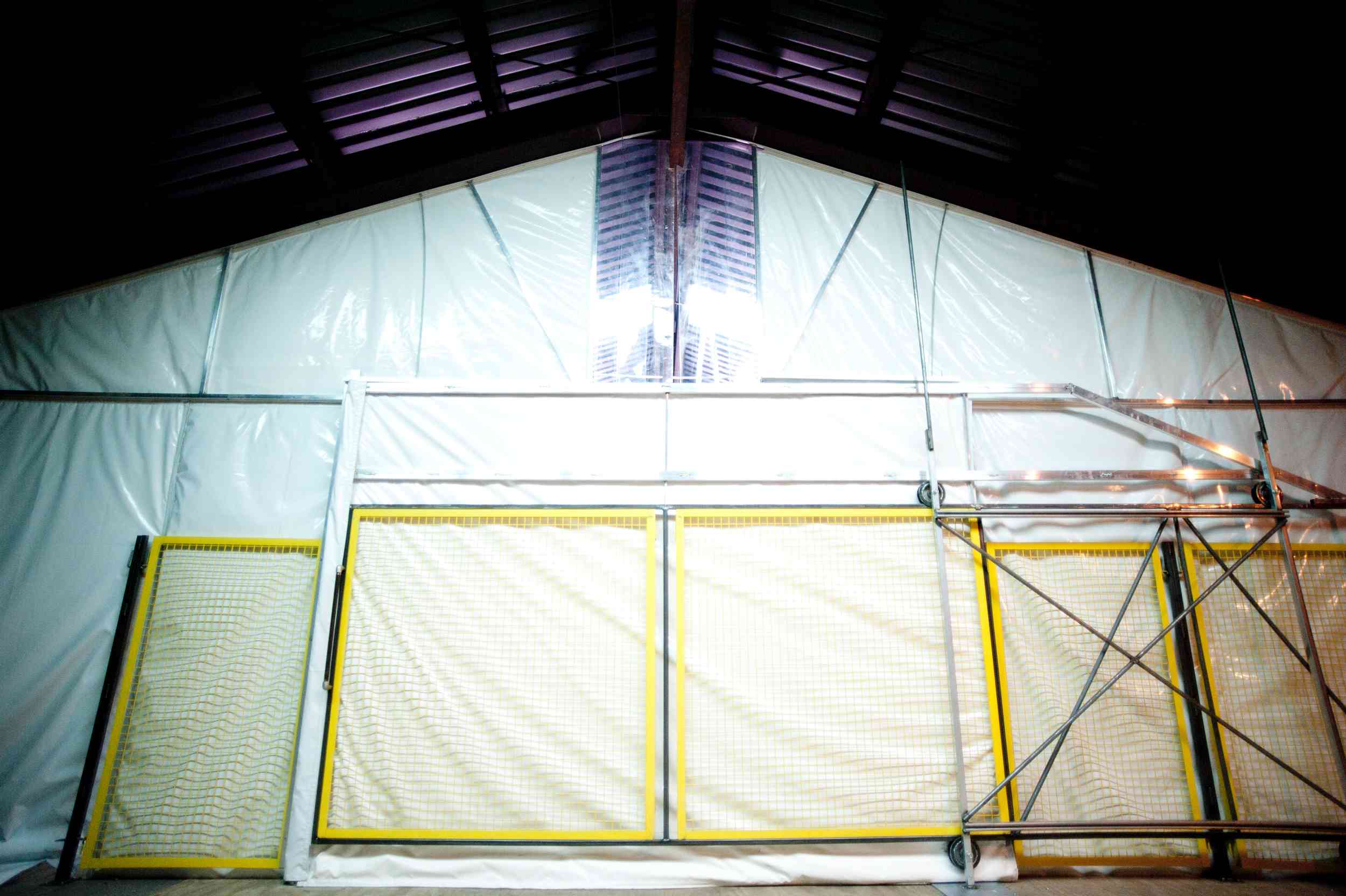
Industrial Insulated Warehouse Curtains that are manufactured with PVC or heavy-duty vinyl. These industrial insulated curtains are in the form of flexible partitions that are often transparent (for maximum visibility). Featuring reinforced edges and track systems, softwall curtains create temporary partitions that separate one temperature zone from the other without the need for structural construction.
These warehouse wall curtains separate cooled zones from unconditioned zones to achieve maximum temperature control. They are commonly used in cold storage areas, pharmaceutical facilities, warehouses, manufacturing zones, and loading docks. Softwall curtains are mostly designed with fold-away feature. This level of flexibility makes these industrial insulated barriers an ideal option for business operations with seasonal demands, fluctuating layouts, or expansion plans.
Hardwall barriers
Hardwall barriers are fixed structures that permanently divide one area from the other in an industrial facility. Constructed using drywall, metal framing, insulated panels, gypsum board, or concrete blocks, these barriers provide solid separation between specific zones to control temperature flow.
These insulation barriers can be a practical option in industrial facilities that have static layouts.

Softwall Curtains Versus Hardwall Insulation Barriers: What’s the Best Option?
Choosing between installing softwall curtains and hardwall barriers can be a high-involvement decision. Therefore, it makes sense to compare the pros and cons of both options. Let’s explore these further:
Pros of softwall curtains
Easy installation: It takes just a few hours to install softwall curtains. This directly minimizes operational downtime.
Low initial cost: Since softwall systems are manufactured with lightweight yet durable insulated vinyl, the overall price is comparatively low compared to fixed walls. Besides, labor costs are also much lower.
Efficient insulation: Softwall curtains are designed with advanced thermal technology. Thus, they provide excellent insulation due to their high R-values ranging from R-3 to R-9 and even up to R-15 (depending on facility requirements).
High flexibility: As business operations evolve, it’s convenient to reconfigure, relocate, and even expand softwall curtains without the extra efforts.
Targeted temperature control: Instead of conditioning the entire large space (unlike fixed walls), softwall curtains can be used to insulate targeted zones only. Facility managers can cool or heat only specific areas that actually need insulation. This way, these warehouse curtain walls help reduce energy consumption and energy costs.
Space optimization: Unlike fixed walls that take a lot of floor space, you can fold softwall curtains away when not in use. This benefit directly saves square footage and provides access to large machinery.
Practical for temporary applications: Ideal for facilities with modular layouts, softwall curtains can be used multiple times even in seasonal operations.
Maintenance: Softwall curtains are easy to clean, repair, and replace. They also require low level of maintenance.
Cons of softwall curtains
Different than permanent construction: Some industrial facilities may prefer a traditional approach to insulation in the form of permanent, finished architectural structures (such as drywall). The visual appearance of softwall curtains differs in this aspect.
May require frequent realignment in high-traffic areas: Warehouses with recurrent forklift traffic might require continuous repositioning of softwall curtains to ensure proper sealing.
Underutilization of the flexibility advantage in static layouts: While softwall curtains are flexible, foldable, and reconfigurable, facilities with static layouts may not fully utilize this adaptability feature.
Pros of hardwall curtains
Enhanced security: Not everyone is allowed to enter storage areas with sensitive products or valuable equipment. Solid walls act as physical barriers that restrict unauthorized access.
Optimum noise reduction: The construction of fixed walls provides superior noise absorption. This feature makes hardwall a feasible option for facilities with noisy equipment.
Simplified operational planning: The fixed setup helps facility managers devise space allocation plans just once. When hardwall insulation barriers are installed, there’s no need to make a new space separation plan or change an existing layout.
Perceived professionalism: Some organizations perceive the permanent appearance of fixed walls as a suitable architectural structure for insulation. Hardwall barriers give a professional appearance to those who prefer solid walls for insulating their industrial facility.
Minimal adjustments: Once installed, hardwalls do not require further alignments. This makes them practical for business operations that prefer permanent insulation barriers instead of focusing on flexibility.
Cons of hardwall curtains
High upfront costs: Hardwall materials and labor contribute to a higher capital investment. Besides, the additional cost of hiring engineers for the preparation of specific hardwall insulation designs can exceed limited budgets.
Immovability: Since hardwall construction is permanent, any modifications (such as expanding a storage area, relocating the insulation barriers, or reconfiguring the layout) is impossible. If still modification is needed, it requires complete demolition and reconstruction.
Lengthy installation: Depending on wall complexity, contractor availability, and facility size, it may take several weeks or even a few months to construct hardwall insulation barriers. During this timeline, workflow as well as operational processes can be affected.
Limited operational flexibility: Storage requirements may evolve rapidly in some warehouses. Future expansion plans and seasonal changes are other scenarios that require frequent changes in operational layouts. Having hardwall insulation barriers restricts such warehouses to adapt flexibility.
ROI Breakdown
Analyzing the long-term value and operational savings can clarify the ROI breakdown of softwall curtains and hardwall construction.
Let’s look at it in detail.
Softwall curtains
Energy efficiency can be improved within manufacturing facilities. Softwall curtains effectively contribute to this savings objective. Having thermal barriers, softwall curtains drastically reduce cooling and heating costs. This level of energy efficiency directly impacts the annual savings of industrial facilities. Facility managers can recover their capital investment within six months to a year by saving energy through these industrial insulated curtains alone.
Since installation costs (including labor) are low, the return on investment is quick. Flexible reconfiguration and reduced downtime make additional savings possible. The ROI continues to grow because softwall curtains are reusable and reconfigurable over five to ten years of their lifespan without the need for additional expenses.
Hardwall barriers
Hardwall barriers require higher investment (with additional cost for permitting). Therefore, financial returns can only be noticed over a period of several years. However, these insulation barriers have low maintenance costs on a long-term basis.
The ROI of hardwall investments may vary depending on the complexity of construction and the energy savings. The payback timeline may extend to five or even fifteen years. While investing in hardwall barriers justifies itself over many years of usage, it requires facility managers to have a long-term outlook and wait for a specific time period.
Softwall curtains or hardwall barriers – Which One to Choose for Your Facility?
If you have limited budget and the operational needs of your facility are rapidly changing, softwall curtains are a suitable option. These warehouse wall curtains are also an ultimate choice when urgent insulation, immediate energy conservation, and energy savings are the primary objectives.
If budget isn’t an issue and your facility layouts don’t require reconfiguration or modification for at least the next decade, hardwall insulation can work well.
The Takeaway
Now that you are aware of the two most commonly used types of insulation barriers, it will become easier to decide which one to choose. The key is to analyze specific insulation requirements of your facility, and invest in high-quality industrial insulated curtains accordingly.
While hardwall insulation is ideal for specific industrial applications that prefer static layouts and permanent structures, softwall curtains excel when the goal is to insulate temperature-sensitive areas including large warehouses, loading docks, food processing workspaces, cold storage, and freezer areas at minimal cost and in a flexible way.
The key is to ensure you’re ordering the right size. If your insulation needs require a different size, the best option is to opt for softwall curtains that are available in custom sizes.
Recent Posts
- Designing Safe Robotic Cells Using Machine Guard Fencing
- Sound Enclosures vs. Active Noise Control Technology (ANC): Which Works in Industrial Settings?
- When Industrial Curtain Walls Fail — Real-World Failure Modes & How to Design Them to Prevent Costly Incidents
- Softwall vs Hardwall Insulation Barriers: Pros, Cons, and ROI Breakdown
- ‘Clean Zone’ or ‘Cross-Contamination Nightmare’? How to Tell If Your Warehouse Passes the Test
- The Silent Safety Hero: Why Fixed Draft Curtains Are Required in High-Rack Storage Facilities
- The Invisible Risk: How Contamination Happens Without Proper Warehouse Barriers
- Are Your Insulated Warehouse Curtains Compliant
- Understanding Noise Regulations – When Is a Temporary Noise Barrier Legally Required?
- 7 Powerful Ways Industrial Curtain Walls Boost Employee Productivity
Categories
- Accordion Fold Curtains
- Acoustic Baffles
- Agri-Shield Curtains
- Auto Body Shop Curtains
- Bio Plastics
- Draft & Smoke Curtains
- Industrial Divider Curtains
- Industrial Safety Products
- Insulated Curtain Walls
- Machine Guard Safety Fencing
- Mesh Curtain Screens
- News
- Outdoor Curtains
- PVC Strip Curtains
- Smoke & Draft Curtains
- Soundproof Noise Blocking Curtains
- Spray Paint Booth Curtains
- Tarps
- Thermal Curtains & Covers
- Uncategorized
- USDA Wash Down Curtain
- Warehouse Dividers
- Welding Blankets
- Welding Curtains
- Welding Screens