IN A WORLD OF SHORTCUTS, WE DON'T™


High Temperature Strip Curtains
Improve Oven Cycle Times and Stop Wasting Thousands of Dollars in Energy Loss with Steel Guard’s Heat Resistant Strip Curtains
High temperature strip curtains from Steel Guard Safety are typically used to contain heat loss and control internal oven temperatures. The High Temperature Strip Curtains allow a passthrough solution for areas where product or people need to move through while containing extreme temperatures. Commonly used on ovens, such as coke ovens that feed parts, these strip curtains shield and insulate against extreme industrial heat during the passthrough.
Unlike standard PVC strip curtains, which only have heat tolerance to 180°F, our heat shield strip curtains are built on a 1000°F E-glass base fabric with coatings selected for your operating temperature, or on vermiculite coated silica rated to 1800°F for forge and foundry work. Every curtain is manufactured to your opening in our own facility. See the full Industrial Heat Resistant Curtains category for panel systems and related products.
Find Your Operating Temperature
Oven type alone doesn’t determine the material — a powder coat line could take any of our three coated fiberglass builds depending on whether the problem is energy loss, contamination, or strips wearing out from traffic. What does determine it is your operating temperature, and the split is clean. Coating, drying and curing processes nearly all run under 500°F. Heat treating processes nearly all run above 1000°F.
| Process | Typical Operating Temperature | Strip Curtain Range |
|---|---|---|
| Drying ovens | 150–400°F | HTS-1000 / 2000 / 3000 |
| Paint bake | 250–400°F | HTS-1000 / 2000 / 3000 |
| Adhesive and composite cure | 250–400°F | HTS-1000 / 2000 / 3000 |
| Screen print and textile dryers | 300–350°F | HTS-1000 / 2000 / 3000 |
| E-coat cure | 350–375°F | HTS-1000 / 2000 / 3000 |
| Powder coat cure | 350–450°F | HTS-1000 / 2000 / 3000 |
| Bakery and food processing | 300–500°F | HTS-1000 / 2000 / 3000 |
| Tempering | 300–1200°F | Depends on set point — call us |
| Stress relief | 1100–1250°F | HTS-4000 |
| Annealing, steel | 1300–1600°F | HTS-4000 |
| Hardening and austenitizing | 1500–1700°F | HTS-4000 |
| Brazing | 1800–2100°F | HTS-4000 or custom |
| Forge and billet heating | 2100–2300°F | Custom — call us |
| Iron and steel pouring | 2500°F and above | Custom — call us |
Tempering is the one process that straddles the range. Set points vary widely by alloy and specification, so tell us your actual operating temperature rather than the furnace’s rated maximum.
Once you know your band, the model is chosen by the problem you’re solving rather than by heat. Under 500°F: HTS-1000 for general containment and abrasion, HTS-2000 for energy loss and radiant heat, HTS-3000 for contamination and buildup on coating lines. Above 1000°F: HTS-4000.
Choose Your Strip Curtain Material
Strip curtains are not a temperature ladder. Three of our four builds run in the same 482–500°F service class on the same 1000°F base fabric, and they differ by the problem they solve rather than by heat. Match the build to your failure mode, not to your oven’s set point.
| Model | Material | Continuous Rating | Base Fabric | Built For |
|---|---|---|---|---|
| HTS-1000 | 32 oz silicone coated fiberglass | 500°F | 1000°F E-glass | General heat containment, abrasion from traffic |
| HTS-2000 | Silicone coated fiberglass + aluminized fiberglass, two layer | 482°F | 1000°F E-glass | Radiant heat, energy loss, operator comfort |
| HTS-3000 | PTFE coated fiberglass, two layer | 500°F | 1000°F E-glass | Coating lines, contamination and buildup |
| HTS-4000 | Vermiculite coated silica | 1800°F | Amorphous silica | Forge, foundry, kiln, molten splash |
Industrial Heat Shield Strip Curtain — Benefits
- Saves thousands of dollars in wasted energy from industrial ovens
- Reduces the risk of workplace accidents such as burns from radiant heat temperature leaks
- Increases manufacturing cycles due to faster oven pre-heat times
- Allows for stable oven temperatures, resulting in consistent product quality
Industrial High Temperature Strip Curtain — Features
- Two-layer HTS-2000 system combines silicone coated fiberglass with aluminized fiberglass to retain convective heat inside the oven while reflecting radiant heat back from the door opening
- Built on a 1000°F E-glass base fabric, with the coating determining the continuous service rating
- Sewn with stainless steel thread throughout — fiberglass and PTFE threads cap out at 500–600°F, stainless does not
- Thick silicone coating gives excellent abrasion resistance as materials move through the oven doors
- Grommets punched on 2″ centers to match standard strip door mounting hardware, with optional universal galvanized mounting for face mount, eave, wall, or suspended installation
- Individual strips are replaceable — replace what wears rather than the whole curtain
- Built to any opening, from 3′ x 4′ batch oven doors and conveyor slots to openings 10′ wide and larger
Strip Curtains vs. Panel Curtains
Strip curtains are a passthrough. Product and personnel move through them continuously without opening anything, which is why they suit conveyor lines and high-traffic oven doorways. Panel curtains cover an opening or isolate an area and are moved aside or tracked open. If your application calls for full coverage rather than passthrough, see our High Temperature Curtains line.
Overlap and Strip Width
Almost every strip curtain overlap guide is written for thin PVC, and those numbers don’t transfer to coated fabric. At 50% overlap someone is pushing through two layers of heavy coated fiberglass. We build three configurations on a 2″ grommet grid:
- Full overlap, 50% — 8″ strips on 4″ centers. Complete double coverage and the best heat containment. Takes the most effort to push through.
- Mid overlap, 33% — 6″ strips on 4″ centers. Same strip count, easier passage, still a real barrier.
- Butt joint — strips meet edge to edge. Lowest resistance and best visibility, right for continuous conveyor passthrough where drag would mark the finish.
Understanding Temperature Ratings
Almost every temperature rating in this industry describes the base fabric, not the finished curtain. A coated fabric is a substrate plus a coating, and they fail at very different temperatures. Our E-glass base fabric holds to 1000°F, but the silicone coating on it stops at 500°F and PTFE decomposes around 660°F. That gap is why a curtain can be honestly described as 1000°F material and still carry a 500°F service rating.
Steel Guard publishes the continuous rating of the limiting layer in each build and names which layer it is. If a curtain you’re comparing is advertised well above 1000°F, ask the supplier for the standalone maximum operating temperature of the coating, separate from the base fabric. We’ll send you the manufacturer’s data sheet for any material we build with.
On the two-layer HTS-2000, the aluminized foil laminate is the limiting layer at 482°F continuous and 518°F short term. It hangs facing the heat source so radiant energy is stopped before it enters the assembly. Tell us your operating temperature and we’ll confirm the right build and orientation for your opening.
Common Applications
Steel Guard Safety’s high temp strip curtains are an excellent way to cover continuous conveyor ovens in a variety of industrial processes, including composite curing and heat treating. These oven entrance and exit areas create significant energy waste as well as problems with product consistency when left uncovered or fitted with low-temperature PVC strip curtains.
Beyond conveyor ovens, common installations include walk-in batch and cabinet ovens where doors stand open during cart loading, powder coat and paint bake lines, e-coat and pretreat stage separation, drying ovens, and foundry and forge openings where radiant heat and molten splash reach the aisle.
Contact one of our experienced sales reps to evaluate and design a solution at 1-800-347-8368, or request a quote online.
High Temperature Strip Curtain Systems
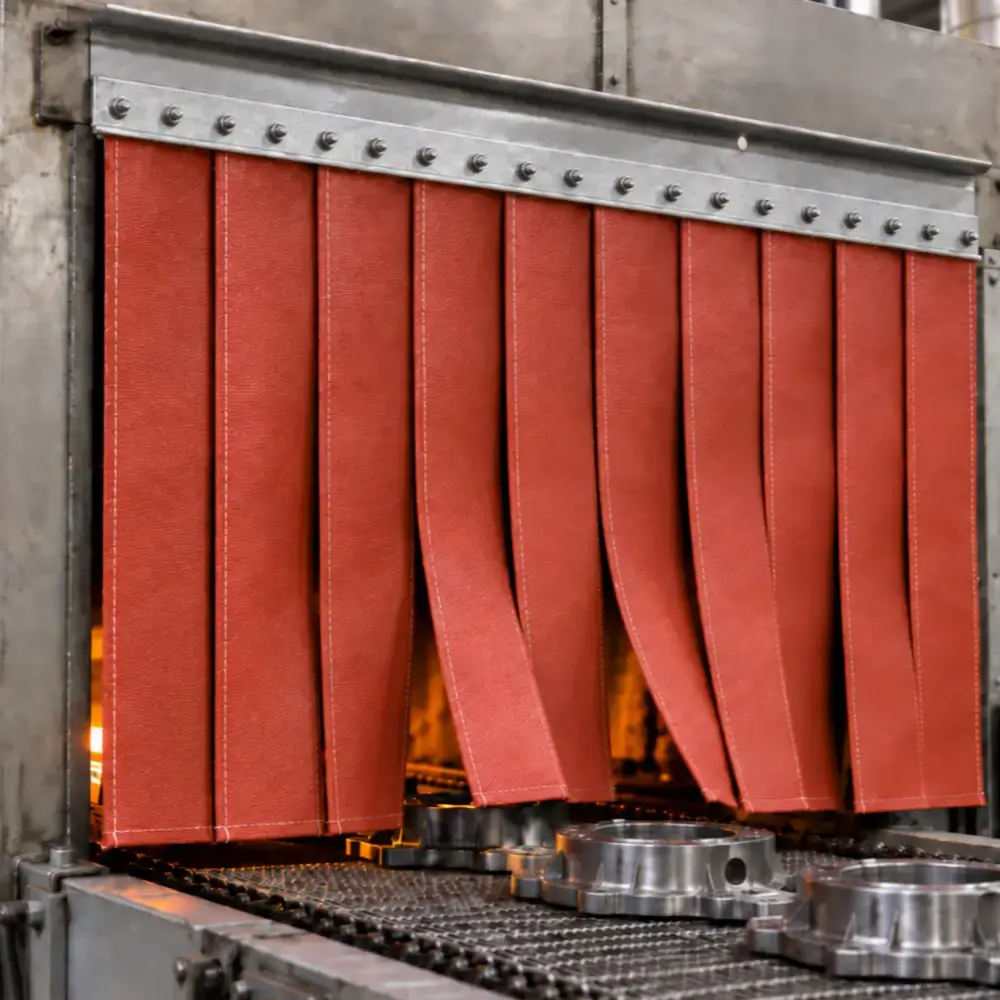
HTS-1000 Silicone Coated Fiberglass Strip Curtains
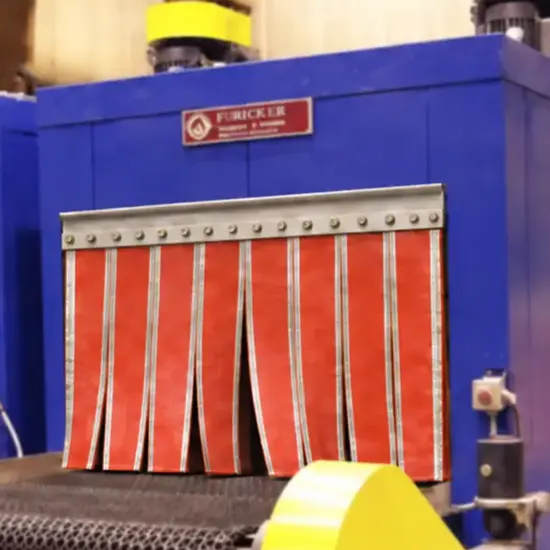
HTS-2000 Reflective Aluminized Strip Curtains
Two-Layer Strip Curtains Combining Silicone Coated Fiberglass with an Aluminized Fiberglass Reflective Face. Rated to 482°F Constant on a 1000°F Fiberglass Base. Reflects Radiant Heat Back into the Oven to Cut Energy Loss and Drop Ambient Temperature at the Operator Station.
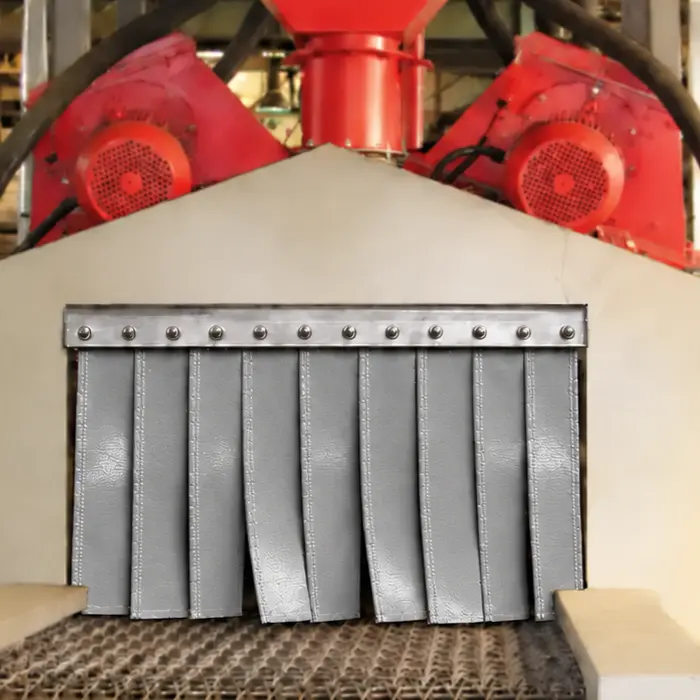
HTS-3000 PTFE Non-Stick Strip Curtains for Ovens
Two Layers of PTFE Coated Fiberglass Rated to 500°F Constant and 600°F Intermittent. No Silicone to Migrate or Contaminate a Finish. Releases Overspray, Resin, and Adhesive. Built for Powder Coat, Paint Bake, and E-Coat Lines. Custom Sized and Available Galvanized Steel Mouting

HTS-4000 Vermiculite Silica Strip Curtains
Vermiculite Coated Silica Strip Curtains Rated to 1800°F Constant. Built for Forge, Foundry, Kiln, and Molten Splash Openings Where Coated Fiberglass Will Not Survive. Anti-Fray Vermiculite Coating for Workability and Splash Resistance. Custom Designed Sizing and Mounting Options