IN A WORLD OF SHORTCUTS, WE DON'T™


American Made, Iron Clad Protected - Discover the Industries Best Warranty.
Blog
How to Transform a Noisy Open-Plan Office with Acoustic Baffles
How to Transform a Noisy Open-Plan Office with Acoustic Baffles
There’s a lot to appreciate about open-plan offices. Easier interaction among team members, flat hierarchies, flexible layouts – all these contribute to the fact that open-plan offices are trending in the corporate world. Such offices also enable businesses to accommodate a higher number of employees within a limited space – thus, achieving cost-effectiveness.
But the challenge begins when a phone rings, a conversation travels outside a workstation, or the typing sound echoes throughout the workplace. So, there’s one downside to open-plan offices: noise pollution.
Constant noise in open-plan offices can cause disturbance, low employee morale, and low concentration levels. Besides, noise in open-plan offices increases mental stress among employees by 25%, according to a study. Consequently, reduced employee productivity leads to hindrances in achieving business objectives.
It’s not worth compromising employee productivity. That said, a loud open-plan office doesn’t have to be that way. Fortunately, you can transform your noisy open-plan office into a quieter and productive workplace by installing acoustic baffles.
Why acoustic baffles are the suitable option for open-plan offices
There are many options when selecting a soundproofing solution for an office setting. However, acoustic baffles are the most appropriate soundproofing options for absorbing sound at open-plan offices due to the following reasons:
Targeted sound absorption: Noise can easily be amplified in open office settings. Acoustic baffles are specifically designed to absorb sound waves in expansive spaces (such as open-plan offices).
Frequency coverage: Even a low pitch of noise can distract employees from carrying out any crucial task. Acoustic baffles can catch and absorb low-frequency sounds to foster pin-drop silence at the workplace.
Space-friendly: Since baffles can be installed over office ceilings, they absorb noise without taking any extra space.
Aesthetics: Acoustic baffles work in two ways: they absorb excessive sound while simultaneously enhancing the aesthetics of any corporate setting.
How to integrate acoustic baffles in an open-plan office
Installing acoustic baffles can be a high-involvement process because every workspace has unique sound control needs. Thus, it’s wise to devise a detailed plan before adding acoustic baffles to an open-plan office.
You can get started by following these steps:
Step 1: Identify the noisy areas within the office
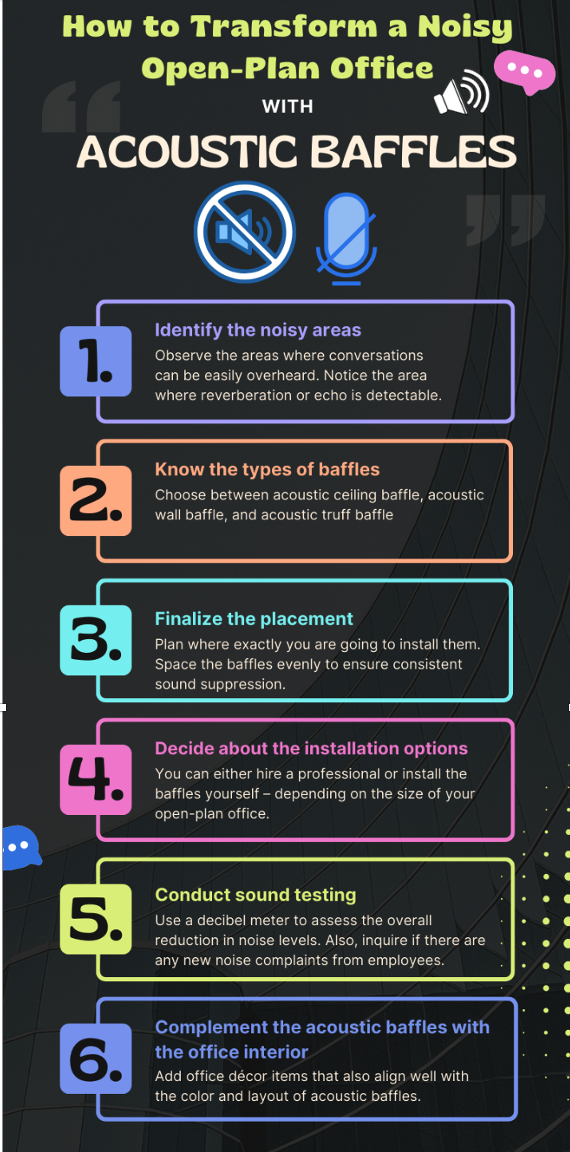
The working-hour time slot is the perfect window to look out for areas where noise is disruptive. So, inspect the workplace when others are busy carrying out their assigned tasks. Observe the areas where conversations can be easily overheard. Notice the area where reverberation or echo is detectable. You can also conduct employee surveys to collect insights about the noise they find most disturbing.
Step 2: Know the types of baffles and choose accordingly
Every workplace layout is different (even in open workspaces). Therefore, it’s important to choose a baffle type that aligns well with its soundproofing needs:
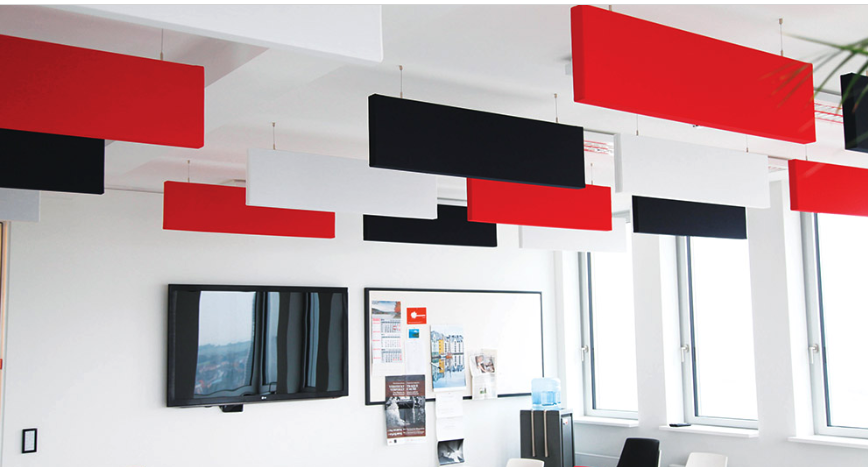
Acoustic ceiling baffle: it’s the best acoustic baffle for open office layouts that have high ceilings but minimal wall space. You can choose this option if you want to add a spacious feel to the workplace.
Acoustic wall baffle: it absorbs sound from specific areas that are near the walls. It’s a decorative as well as effective soundproofing option for offices that have larger wall space.
Acoustic truss baffle: it’s useful for open-plan offices that require a wider acoustic coverage. It also provides high aesthetic appeal to any workspace.
Step 3: Finalize the placement
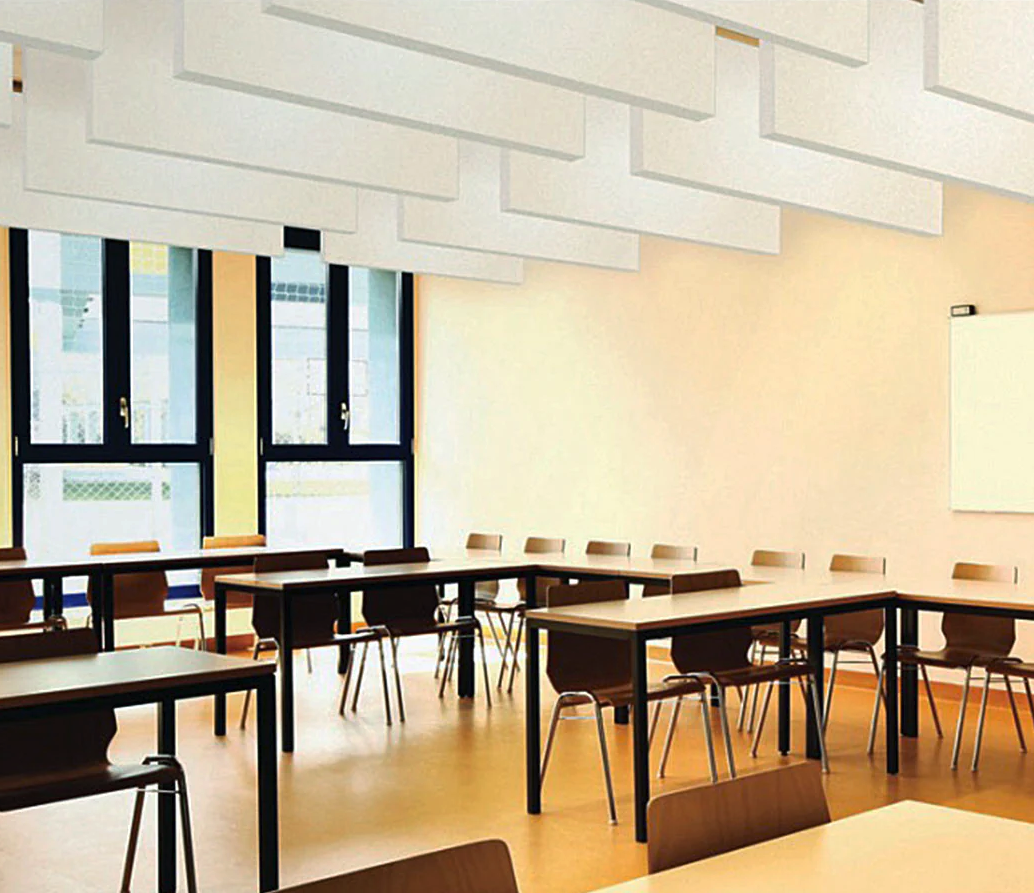
Once you’ve chosen your preferred type of acoustic baffles, plan where exactly you are going to install them. The key is to install the baffles above collaborative workspaces or workstations. You should space the baffles evenly to ensure consistent sound suppression.
It’s also crucial to know that the acoustic baffles are not blocking any lighting or airflow. Therefore, baffles should be mounted at least 20-23 inches below any ceiling. You can attach wall baffles to the walls by using Velcro mounting.
Step 4: Decide about the installation options
You can either hire a professional or install the baffles yourself – depending on the size of your open-plan office. If you’re running a small business in a limited office space, you might need a small setup of acoustic baffles. In this situation, you can install acoustic baffles on your own. Still, you need some basic understanding of installing acoustic baffles at the workplace.
Large open-plan offices require flawlessly installed acoustic baffles. Such office settings might also have complex ceilings (like exposed beams and T-bars). In this situation, it’s wise to go for professional installation.
Step 5: Conduct sound testing
After installing acoustic beams, it’s time to evaluate the results of the acoustics. You can use a decibel meter to assess the overall reduction in noise levels. Also, inquire if there are any new noise complaints from employees.
You can add an additional acoustic system of baffles or reposition the existing baffles to achieve optimum sound absorption at the workplace.
Step 6: Complement the acoustic baffles with the office interior
Nothing compares to office décor that also aligns well with the color and layout of acoustic baffles. To complete the entire look of an open-plan office, place thick rugs in the office lounge. Rugs or carpets made with plush materials are good at absorbing sound. You can also place sofas with fabric that absorbs sound.
Another way to enhance the look of wall baffles is to hang abstract art designs on the office walls. But make sure that each office décor item aligns well with the color theme of the baffles. Complete the look by adding low-maintenance indoor plants that look great in office settings.
The Takeaway
Assessing the sound absorption needs of your office workspace and devising a plan is all it takes to transform a noisy open-floor office into a soundproof workplace. High-quality acoustic baffles can last eight to twelve years. But in open-floor offices with a stable level of humidity, they can even last longer. The longevity of these baffles also depends on how well you can maintain them. Routine cleaning is the way to go.
Since acoustic baffles can be customizable, it’s a good idea to replace them with new ones if your office layout upgrades. You can choose a color that matches the new office layouts.
Recent Posts
- 7 Powerful Ways Industrial Curtain Walls Boost Employee Productivity
- Noise Enclosures vs. Traditional Soundproofing: Which Is Right for Your Facility?
- Steel Guard Safety Achieves SBA HUBZone Certification, Expanding Government Market Opportunities
- 5 Myths and 5 Truths about Smoke Curtains
- 7 Common Mistakes to Avoid When Setting Up Machine Guarding Fences
- Industrial Curtain Walls: 6 Reasons Why Manufacturing Facilities Must Have Them
- Industrial Soundproof Curtains: How to Decide Between Floor-Mounted and Ceiling-Mounted Curtains
- How to Transform a Noisy Open-Plan Office with Acoustic Baffles
- A Guide to Choosing the Best Concrete Blanket for Construction Projects
- Porch Curtains: 8 Amazing Reasons to Install These Curtains in Your Home
Categories
- Accordion Fold Curtains
- Acoustic Baffles
- Agri-Shield Curtains
- Auto Body Shop Curtains
- Bio Plastics
- Industrial Divider Curtains
- Industrial Safety Products
- Insulated Curtain Walls
- Machine Guard Safety Fencing
- Mesh Curtain Screens
- News
- Outdoor Curtains
- PVC Strip Curtains
- Smoke & Draft Curtains
- Soundproof Noise Blocking Curtains
- Spray Paint Booth Curtains
- Tarps
- Thermal Curtains & Covers
- Uncategorized
- Warehouse Dividers
- Welding Blankets
- Welding Curtains
- Welding Screens