IN A WORLD OF SHORTCUTS, WE DON'T™



High Silica Cloth Curtains


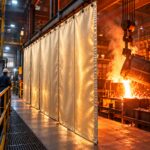
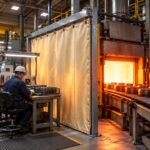

Broken Twill Silica Curtains Rated 1900°F Continuous for Heat Treat Furnaces, Forge Shops and Foundry Openings
High silica cloth curtains from Steel Guard Safety are the grade we build most often and the one to start with above 1000°F. Woven from 95%+ amorphous silica in a broken twill construction, they handle continuous temperatures to 1900°F with a 3000°F melting point — a different material class from every coated fiberglass curtain on the market.
We build them in single and double layer construction, sewn with stainless steel thread, in heights from 8 to 25 feet and any width. For the full material range including reflective and non-stick grades, see our High Temperature Curtains line.
Why Silica Instead of Coated Fiberglass
Above 1000°F, coated fiberglass stops being an option. E-glass — the substrate under every silicone, PTFE, acrylic and aluminized curtain — gives out around 1000°F no matter what coating sits on top of it. A curtain advertised at 2000°F on a fiberglass base is describing something other than what the fabric will survive.
Amorphous silica is a different material entirely. At 95%+ SiO2 it handles 1900°F continuously and melts at 3000°F, with no coating in the assembly to fail first. The whole fabric carries one number, which is why it is the only grade we recommend for sustained furnace temperatures.
The trade is that silica gives up what coatings provide. No chemical barrier, no release surface, no reflective face, and the fabric is more friable than coated goods. Below 1000°F a coated grade will usually serve you better for less money.
How Silica Is Rated, and Why the Numbers Get Confused
Silica fabric carries three different temperature figures, and they are routinely mixed up in product listings:
| Figure | Our Material | What It Describes |
|---|---|---|
| Continuous service | 1900°F | The temperature the fabric holds indefinitely in service. This is the number that governs. |
| Melting point | 3000°F | Where the fiber itself gives out. A material property, not an operating limit. |
| Base fabric limit | N/A | Relevant only on coated fabrics, where a coating fails before the substrate. Uncoated silica has no such gap. |
A curtain advertised at a single number somewhere between a continuous rating and a melting point is usually quoting one and calling it the other. Ask any supplier which of the three figures their number represents. On uncoated silica there is no coating to fail first, which makes it the cleanest case in the category — the fabric rating is the product rating.
Broken Twill Construction
Most silica curtains are built from satin weave cloth. We use a broken twill construction, which Alpha states improves handling over conventional satin weave, with a proprietary surface finish applied on top of that.
That matters more than it sounds. Silica’s weakness has never been temperature — it is that the fabric frays at the cut, sheds fiber, and is unpleasant to work with. Broken twill and the surface finish address exactly that, which shows up as a cleaner hem, less shedding in service, and a curtain that holds together better at the grommet line.
It is also stronger. At 610 lbs warp and 346 lbs fill, the fabric carries roughly 30% more tensile strength than the satin weave silica it replaces, from a lighter and thinner cloth.
Single Layer or Double Layer
Both use the same cloth. The second layer roughly doubles the material and changes what the curtain does.
| Build | Construction | Choose When |
|---|---|---|
| HHC 1L — Single layer | 32 oz, one ply | Radiant shielding, aisle separation, general barrier duty. The lighter, more economical build and the right one for most openings |
| HHC 2L — Double layer | 32 oz, two ply | Sustained high radiant load, added insulating value, longer service life at the top of the range, or where the curtain sees mechanical contact as well as heat |
The double layer adds thermal resistance two ways: twice the fabric, plus the air space between plies. Thermal resistance in layered fabric assemblies increases with the air gap between layers, and the benefit is greatest where airflow across the opening is minimal.
If you are uncertain, tell us the set point, the opening size, and how close personnel work to it. On a furnace door that stands open during charging, the double layer usually pays for itself in service life; on an aisle divider twenty feet from the source, the single layer is the better value.
Where High Silica Curtains Are Installed
Heat treat furnace charge and discharge ends. Box furnaces, car bottom and bogie hearth furnaces all expose the full opening during every cycle. A silica curtain holds temperature during the load and shields the operator from the radiant dump.
Continuous belt furnace throats. Entry and exit openings on mesh belt lines, where radiant loss runs constantly at both ends.
Forge shops and billet heating. Induction heater entry and exit, and screening between the forge line and adjacent work areas.
Foundry aisle separation. Shielding adjacent bays from radiant heat and splash at pour lines, ladle preheat stations and shakeout transitions.
Stress relief and annealing. Sustained temperature with personnel access, where the curtain runs at temperature for hours rather than minutes.
Kiln and lehr openings. Glass, ceramic and refractory processes with continuous thermal load.
Furnace Processes and Operating Temperatures
| Process | Typical Operating Temperature | HT-3000 Fit |
|---|---|---|
| Stress relief | 1100–1250°F | Well within range |
| Annealing, steel | 1300–1600°F | Well within range |
| Normalizing | 1500–1650°F | Well within range |
| Hardening and austenitizing | 1500–1700°F | Within range |
| Brazing | 1800–2100°F | At or near limit — depends on standoff |
| Forge and billet heating | 2100–2300°F | Above continuous limit — depends on standoff |
| Iron and steel pouring | 2500°F and above | Above continuous limit — depends on standoff |
| Tempering | 300–1200°F | Depends on set point — a coated grade may serve better below 1000°F |
The curtain hangs at the opening rather than inside the chamber, so the fabric sees door-plane temperature instead of furnace set point. A furnace running above 1900°F can still be a viable application depending on opening geometry and standoff distance. Tell us the set point and the mounting position and we will tell you honestly whether it works.
What Silica Will Not Do
- It is not a reflective barrier. Silica absorbs radiant energy and re-radiates it. If the problem is energy loss or operator comfort rather than survival, our aluminized build reflects instead.
- It is not a contamination barrier. Silica sheds fiber. On a coating line where surface contamination is the concern, use our PTFE build.
- It is more friable than coated fabric. The broken twill weave and surface finish improve this considerably over standard satin weave silica, but it still generates more dust when cut than a coated fabric does.
- It shrinks at the top of the range. Silica shrinks linearly under sustained high temperature. Curtains specified near 1900°F are built long to preserve bottom coverage.
Construction
- Broken twill silica, 95%+ SiO2, 32 oz/sq yd, 0.045″ per layer
- Single or double layer, priced per linear foot of width at your specified height
- 60-inch roll width, which means fewer seams on wide panels than the 36- and 40-inch silica cloths common in this category
- Stainless steel thread throughout. Fiberglass thread caps at 1000°F and PTFE thread at 600°F — neither belongs on a 1900°F curtain, and a thread failure drops a panel regardless of how the fabric is holding up
- Grommets every 12 inches across the top with reinforcement, with optional chain bottom and track systems
- Tracks or hangs fixed. No foil laminate, so no static-only restriction
- Contains no asbestos and no ceramic fibers
- Heights 8 to 25 feet standard, larger available,
Tell us the opening dimensions, your operating temperature, and how close personnel work to it. Call 1-800-347-8368 or request a quote online.
HT-3000 Material Specifications
| Property | Value |
|---|---|
| Material | broken twill silica fabric |
| Silica content | ≥95% SiO2 |
| Weave construction | Broken twill |
| Nominal weight | 32 oz/sq yd |
| Nominal thickness | 0.045″ per layer |
| Thread count | Warp 47, fill 25 |
| Continuous service temperature | 1900°F / 1038°C |
| Intermittent | 1900°F / 1038°C |
| Melting point | 3000°F / 1649°C |
| Tensile breaking strength, warp | 610 lbs |
| Tensile breaking strength, fill | 346 lbs |
| Surface finish | Proprietary finish for improved handling |
| Roll width | 60 inches |
| Roll length | 50 yards |
| Asbestos content | None |
| Ceramic fiber content | None |
| Reflective | No |
Unlike a coated fabric, there is no coating to fail before the substrate. The fabric carries one rating end to end, which is why it is the grade we specify above 1000°F.
Curtain Construction
| Component | Specification |
|---|---|
| Builds available | Single layer (HHC 1L) or double layer (HHC 2L) |
| Thread | Stainless steel |
| Grommet spacing | 12 in on center, top, with reinforcement |
| Cut direction | Warp vertical — 610 lbs warp against 346 fill |
| Mounting | Track systems or fixed — no static-only restriction |
| Optional | Chain bottom, track and trolley hardware |
| Standard heights | 8 to 25 feet; larger available |
| Maximum width | No limit — built to opening |
| Pricing basis | Per linear foot of width at your specified height |
Handling and Safety
Silica fabric is more friable than coated fiberglass. The broken twill construction and surface finish improve handling considerably over standard satin weave silica, but cutting, drilling or abrading the material still generates dust that causes mechanical skin, eye and respiratory irritation. Handling calls for gloves, safety glasses with side shields, and a NIOSH particulate respirator where dust is generated. Work clothing should be laundered separately from other clothing.
Silica subjected to sustained temperatures above its service rating may partially convert to cristobalite, a crystalline form of silica with a significantly lower permissible exposure limit. Material coming out of service near the top of its range should be handled accordingly.
The fabric contains no asbestos and no ceramic fibers. A full Safety Data Sheet is supplied with every order and available on request.
The HT-3000 is our high silica cloth build and the grade to start with above 1000°F. It handles 1900°F continuous with a 3000°F melting point, which makes it the right choice for heat treat furnace openings, forge shops, foundry aisles and kiln access. It is the grade we build most often.
Above 1000°F coated fiberglass stops being an option. E-glass — the substrate under every silicone, PTFE, acrylic and aluminized curtain — gives out around 1000°F no matter what coating sits on top of it. Amorphous silica is a different material class entirely, handling 1900°F continuous with no coating in the assembly to fail first. Below 1000°F a coated grade will usually serve you better for less money.
Most woven silica is published at 1800°F continuous — that figure is consistent across all manufacturers. Ours is a broken twill construction rated 1900°F, which is above the category standard. A flat 2000°F claim sits above every published continuous rating and below every published melting point, which usually means a peak or short-duration figure is being quoted as a service rating. Ask any supplier which of the three figures their number represents: continuous service, peak exposure, or melting point.
Most silica curtains use a satin weave. Broken twill is a different construction that improves handling, and ours carries a proprietary surface finish on top of that. Silica’s weakness has never been temperature — it is that the fabric frays at the cut, sheds fiber and is unpleasant to work with. Broken twill addresses exactly that, which shows up as a cleaner hem, less shedding in service and better integrity at the grommet line. It is also about 30% stronger in the warp direction than the satin weave silica it replaces.
Both use the same cloth; the second layer roughly doubles the material. Single layer is the lighter, more economical build and the right one for most openings — radiant shielding, aisle separation, general barrier duty. Double layer adds thermal resistance two ways, through twice the fabric and through the air space between plies, and is the better choice on a furnace door that stands open during charging or anywhere the curtain sees sustained high radiant load.
Possibly. The curtain hangs at the opening rather than inside the chamber, so the fabric sees door-plane temperature instead of furnace set point, and those can differ substantially depending on opening geometry and standoff distance. Tell us the set point, the opening dimensions and the mounting position, and we will tell you honestly whether it works or whether you need a different solution.
Silica shrinks linearly under sustained exposure near the top of its range. Curtains specified at those temperatures are built long to preserve bottom coverage as the material settles. Below roughly 1500°F the effect is minimal.
No. Silica absorbs radiant energy and re-radiates it rather than reflecting it back to the source. If your problem is energy loss through an opening or radiant heat reaching an operator station, our HT-4000 aluminized build adds a reflective face. If the problem is surviving the temperature, silica is the answer.
Not ideally. Silica sheds fiber, which is the opposite of what a coating environment wants. For powder coat, paint bake and e-coat lines where surface contamination is the concern, use our HT-2000 PTFE build — it contains no silicone and releases overspray rather than holding it.
Stainless steel throughout. Fiberglass thread caps at 1000°F and PTFE thread at 600°F — neither belongs on a 1900°F curtain, and a thread failure drops a panel regardless of how well the fabric is holding up.
Yes. Unlike our reflective grades, which use a foil laminate specified for static installation only, this build has no such restriction. It works on our track and roller system for moveable installations, or hangs fixed.
Yes. Silica fabric is more friable than coated fiberglass, and cutting or abrading it generates dust that causes mechanical skin, eye and respiratory irritation. Gloves, safety glasses with side shields, and a NIOSH particulate respirator are called for where dust is generated. Material that has been in service near its temperature limit may contain cristobalite and should be handled accordingly. The fabric contains no asbestos and no ceramic fibers. A full SDS ships with every order.
The HT-1000 in acrylic treated fiberglass is the spark and abrasion grade, ANSI/FM 4950 approved for welding curtains. The HT-2000 in PTFE coated fiberglass runs 500°F continuous and is chosen for coating lines and chemical exposure. The HT-3000 is the high-temperature workhorse at 1900°F. HT-4000 adds an aluminized reflective face for radiant heat and energy loss, and HT-5000 adds an insulating core for holding temperature zones apart. See our High Temperature Curtains page for a full comparison.
Yes. All Steel Guard Safety high temperature curtains are custom manufactured to your dimensions. Panel height, width, grommet spacing and cut-outs for penetrations are all configurable. Call 1-800-347-8368 or request a quote online.