IN A WORLD OF SHORTCUTS, WE DON'T™



Aluminized Silica Cloth Curtain


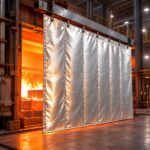
Radiant Heat Shield Curtains That Reflect Energy Back Toward the Source Instead of Absorbing and Re-Radiating It
Aluminized silica cloth curtains from Steel Guard Safety are a three-layer insulated build: a high silica face, a fiberglass needlemat insulation core, and an aluminized fiberglass reflective backing. The silica takes the thermal load at the opening, the core slows the heat conducting through the curtain, and the aluminized backing keeps the cool face from radiating what is left into the work area.
This is the build for radiant heat reaching people and equipment — furnace and foundry openings, operator stations, and anywhere the complaint is that it is unbearable to work next to the heat source. For a barrier without the reflective layer, see our HT-3000 High Silica Cloth Curtains, or the full High Temperature Curtains range.
Why the Silica Faces the Heat
This runs against intuition, so it is worth explaining. Most reflective products put the shiny side toward the heat source, and for a simple radiant barrier that is correct — stopping radiant energy before it enters the assembly keeps everything behind it cooler.
At furnace temperatures that logic breaks down. An aluminized fabric is aluminum foil bonded to a substrate, and the bond is the limiting component. Aluminum itself melts at 1220°F, but the high-temperature adhesive holding it to the fabric gives out around 482°F. Put that face into a 1500°F opening and the foil delaminates — quietly, because the curtain keeps hanging and looking correct while the reflective layer stops working.
Building it the other way solves the problem. The silica face absorbs the thermal load at up to 1900°F, and the insulation core between the silica and the backing keeps the aluminized layer far cooler still. The backing still does its job from the cool side: a low-emissivity surface radiates very little of the heat that reaches it, so the curtain’s outer face does not become a second heat source in the aisle. You get the reflective benefit without asking the foil to survive furnace heat.
Our curtains are built and shipped with the silica face marked. Hang it toward the heat source.
Why There Is an Insulation Core
Silica stops the heat from burning through the curtain, but on its own it conducts heat straight into whatever sits behind it. A single silica ply over a reflective backing lets the backing run hot, and at a furnace door it can run past the adhesive’s limit.
The fiberglass needlemat core breaks that path. It holds a temperature difference across the curtain, which does two things: it keeps the reflective backing well inside its 482°F limit, and it keeps the cool face cool enough to work next to. Radiant heat is reflected, conducted heat is insulated, and the curtain handles both in one build.
The three layers are quilted in 24-inch sections and tied at each section center with stainless steel thread bar tacks, so the core stays in place when the curtain hangs. We use thread rather than metal quilting pins here on purpose: a metal pin would carry heat straight from the silica face to the backing.
What the Reflective Layer Does
Radiant heat transfer scales with the fourth power of temperature, which means it goes from a minor contributor at moderate temperatures to the dominant loss mechanism as a source gets hotter. At a furnace opening, most of what reaches an operator is radiant energy, and ordinary fabric does not stop it — the fabric absorbs it, heats up, and re-radiates it into the room.
A low-emissivity aluminized surface behaves differently. Instead of absorbing and re-emitting, it reflects. Three effects follow:
- Lower ambient temperature at the operator station, because the radiant load reaching the aisle is reduced rather than just delayed
- Cooler outer face on the curtain itself, which matters where people work close to it
- Less energy loss through the opening, since reflected energy returns to the process rather than heating your building
Foil, Not Metallized Film
Most reflective industrial fabrics use an aluminized polyester or Mylar film laminated to a substrate. It is inexpensive and reflects well, but the film itself begins to decompose between 400°F and 450°F, and decomposition products are not something you want outgassing in an occupied doorway.
Our backing uses an aluminum foil laminate bonded with a high-temperature adhesive. There is no polymer film in the assembly — nothing to haze, outgas or delaminate from thermal decomposition. Combined with the silica face taking the load, the reflective layer sits in conditions it can survive indefinitely.
Where Radiant Heat Shield Curtains Are Installed
Operator stations near furnace openings. The most common reason customers call about this product. Where the complaint is that it is unbearable to work near the source, radiant load is almost always the cause and reflecting it back is the direct fix.
Foundry and forge aisle separation. Shielding adjacent bays from radiant heat at pour lines, ladle preheat stations and shakeout transitions.
Heat treat furnace charge and discharge ends. The opening stands exposed during every cycle and the radiant dump reaches well into the aisle.
Electric arc and reheat furnace shielding. Where both radiant load and conducted heat are severe, and the insulation core earns its place.
Energy containment on continuous openings. Where the driver is the utility bill rather than operator comfort, and reflected energy returns to the process.
Equipment protection. Shielding sensitive equipment, controls or cabling from radiant exposure near a hot process.
When to Choose Something Else
- Pure temperature survival with no radiant concern — our HT-3000 high silica build costs less and does the job.
- Molten splash contact — our HT-5000 quilted silicone build is made for splash; tell us the exposure.
- Insulation without the reflective layer — our HT-5000 holds temperature zones apart at a lower cost.
- A tracked curtain that opens and closes constantly — the foil laminate prefers static installation. Fixed mounting or infrequent movement is what this build is for.
- Surface contamination on a coating line — use our HT-2000 PTFE build.
What the Reflective Layer Needs to Keep Working
Two conditions, both worth knowing before you order.
It has to stay reasonably clean. Tar, soot, scale and overspray will take a highly reflective surface to a dull absorbing one within days. In a dirty environment the reflective benefit needs periodic cleaning to keep earning its cost.
It fails quietly. Reflectivity degrades before the curtain fails structurally, so a curtain can hang correctly and look serviceable while the radiant barrier has stopped working. Hazing, dulling or discoloration of the reflective face is the signal to look for.
Construction
- Hot face: high silica cloth, 95%+ SiO2, rated to 1900°F continuous
- Insulation core: fiberglass needlemat
- Reflective backing: aluminized fiberglass, aluminum foil laminate with high-temperature adhesive
- Quilted in 24-inch sections with stainless steel thread bar tacks at each section center
- Stainless steel thread throughout. Fiberglass thread caps at 1000°F and PTFE thread at 600°F
- Grommets every 12 inches across the top with reinforcement, with optional chain bottom
- Static mount preferred. The foil laminate is specified for fixed installations rather than curtains cycled open repeatedly
- Silica face marked so it hangs toward the heat
- Built to any opening, heights from 6 to 25 feet standard and larger available
HT-4000 Assembly
| Layer | Material | Rating | Function |
|---|---|---|---|
| Hot face | High silica cloth, 95%+ SiO2 | 1900°F continuous | Takes the thermal load, shields the backing |
| Middle ply (3-ply build) | High silica cloth | 1900°F continuous | Additional thermal resistance for furnace-adjacent work |
| Reflective backing | Aluminized fiberglass, aluminum foil laminate | 482°F continuous, 518°F short term | Reflects radiant energy from the cool side |
The assembly is rated on the hot face. The reflective backing carries its own limit, which is why the silica faces the heat and why we offer a three-ply build for furnace-adjacent installations. Ply count is specified per application based on source temperature and standoff distance.
Hot Face Material
| Property | Value |
|---|---|
| Material | High silica cloth |
| Silica content | 95%+ SiO2 |
| Continuous service temperature | 1900°F |
| Melting point | 3000°F |
| Coating | None — uncoated woven silica |
Reflective Backing
| Property | Value |
|---|---|
| Material | Aluminized fiberglass |
| Reflective layer | Aluminum foil laminate — no polymer film |
| Bonding | High-temperature adhesive |
| Continuous service temperature | 482°F |
| Short term | 518°F |
| Limiting component | Laminating adhesive, not the aluminum |
| Base fabric | 1000°F E-glass |
| Outgassing | None — no polymer film in the assembly |
Curtain Construction
| Component | Specification |
|---|---|
| Builds available | Two-ply (HT-4000) or three-ply (HT-4000-3) |
| Orientation | Silica face toward the heat source — marked at the factory |
| Thread | Stainless steel |
| Grommet spacing | 12 in on center, top, with reinforcement |
| Mounting | Static or infrequently moved; foil laminate is specified for fixed installation |
| Optional | Chain bottom, cut-outs for penetrations |
| Standard heights | 8 to 25 feet; larger available |
| Maximum width | No limit — built to opening |
Handling and Safety
Silica fabric is more friable than coated fiberglass. Cutting, drilling or abrading it generates dust that causes mechanical skin, eye and respiratory irritation. Handling calls for gloves, safety glasses with side shields, and a NIOSH particulate respirator where dust is generated.
Silica subjected to sustained temperatures above its service rating may partially convert to cristobalite, a crystalline form of silica with a significantly lower permissible exposure limit. Material coming out of service near the top of its range should be handled accordingly.
A full Safety Data Sheet is supplied with every order and available on request.
The HT-4000 is a radiant heat shield. It combines a high silica face with an aluminized fiberglass reflective backing, so the curtain reflects radiant energy back toward the source rather than absorbing it and re-radiating it into the work area. It is the build for operator stations near furnace openings, foundry and forge aisle separation, and anywhere the complaint is radiant heat reaching people rather than the curtain simply needing to survive.
Silica face toward the heat source. We mark the face at the factory. This runs against intuition — most reflective products put the shiny side toward the heat — but at furnace temperatures that would destroy the reflective layer. See the next question.
Because an aluminized fabric is aluminum foil bonded to a substrate, and the bond is the limiting component. Aluminum itself melts at 1220°F, but the high-temperature adhesive holding the foil to the fabric gives out around 482°F. Put that face into a 1500°F opening and the foil delaminates — quietly, because the curtain keeps hanging and looking correct while the reflective layer has stopped working. With the silica facing the heat, the aluminized layer stays far cooler and still reflects, because a low-emissivity surface suppresses radiation across the gap between plies regardless of which side of that gap it sits on.
The two-ply HT-4000 is silica face over aluminized backing, and it suits aisle separation, work area division and operator station shielding where the curtain stands off from the source. The three-ply HT-4000-3 adds a second silica layer between the face and the backing, which puts more thermal resistance in front of the reflective layer for furnace-adjacent work — electric arc, reheat, charge and discharge doors. Tell us the source temperature and how far the curtain hangs from it and we will spec the ply count.
It depends on how much thermal load reaches the reflective backing, which is a function of source temperature, standoff distance and opening geometry rather than any single number. As a starting point: aisle separation twenty feet from a source is two-ply work, a curtain hung at a furnace door is three-ply work, and anything between those is worth a conversation. Send us the set point and the mounting position.
Aluminum foil, laminated with a high-temperature adhesive. Many reflective industrial fabrics use aluminized polyester or Mylar film, which is cheaper but begins to decompose between 400°F and 450°F — and the decomposition products are not something you want outgassing in an occupied doorway. Ours has no polymer film in the assembly, so there is nothing to haze, outgas or thermally decompose.
It depends on your source temperature, the opening size and the standoff distance, so we would rather walk through the specifics than quote a percentage that may not apply to your installation. What is reliable is the direction: radiant transfer scales with the fourth power of temperature, so the hotter the source and the larger the opening, the more a reflective face returns. Send us the opening dimensions and set point.
Less well. A reflective surface only works while it stays reflective, and a coating of soot, tar, scale or overspray will take a highly reflective face to an absorbing one within days. If your process produces heavy volatiles or scale, the reflective layer needs periodic cleaning to keep earning its cost, and a plain silica build may serve you better for the money.
Watch the reflective face. Reflectivity degrades before the curtain fails structurally, so a curtain can hang correctly and look serviceable while the radiant barrier has stopped doing anything. Hazing, dulling or discoloration is the signal. Soot and scale buildup produce the same effect without degrading the material, and in that case cleaning restores it.
The HT-1000 in acrylic treated fiberglass is the spark and abrasion grade, ANSI/FM 4950 approved for welding curtains. The HT-2000 in PTFE coated fiberglass runs 500°F continuous and is chosen for coating lines and chemical exposure. The HT-3000 in high silica cloth is the high-temperature workhorse at 1900°F with no reflective layer. The HT-4000 adds the reflective backing for radiant heat, and the HT-5000 adds an insulating core for holding temperature zones apart. See our High Temperature Curtains page for a full comparison.
The foil laminate is specified for static installation rather than curtains cycled open repeatedly. Fixed mounting or infrequent movement is what this build is for. If you need a curtain that rolls open several times a shift, our HT-3000 high silica build has no such restriction.