IN A WORLD OF SHORTCUTS, WE DON'T™



Portable Welding Fume Extractors

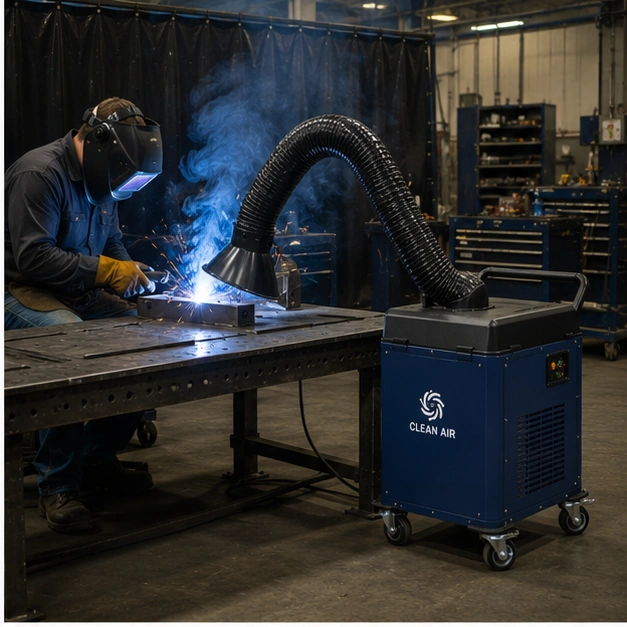



A portable welding fume extractor captures toxic fumes and smoke at the source, before they enter a welder’s breathing zone — without requiring a booth, ducting, or any permanent installation. For the full range of enclosure and extraction options, see our Welding Booths & Fume Extraction line.
Mobility That Fixed Systems Can’t Match
Because the capture arm and hood reposition freely, the operator controls exactly how fumes and smoke are captured, rather than working around a fixed hood position. The entire unit moves wherever it’s needed within the facility — a shared floor of manual welding stations can outfit each welder with extraction without running ductwork to every position.
Built for Manual Welding — MIG, TIG, and Stick
These portable welding fume extractors are designed around manual welding processes: stick, MIG, and TIG, plus soldering applications. Heavy-duty steel cabinet and fume arm construction hold up to daily repositioning and shop-floor use, with standard tool racks built into the unit.
6-7x Filter Life
Filter life on these units runs 6-7 times longer than typical industry standards, cutting down on replacement frequency and the labor that goes with it. Reduced airflow over time is the clearest sign a filter is nearing end-of-life — inspecting filters every 4-6 months catches this before it becomes a compliance issue, with replacement frequency also depending on daily usage hours and whether you’re working oil-coated metal, which generates thicker fume and shortens filter life faster than uncoated material.
Additional Information:
Meeting Fume Exposure Standards
OSHA’s general industry standard for welding fume exposure is 5 mg/m³, but a growing number of manufacturers are adopting internal limits as low as .02 mg/m³ — in line with ACGIH threshold limit values for manganese in welding fume — as they align with international standards ahead of regulatory change. A portable welding fume extractor is often the fastest way to bring an existing shop floor into compliance without a facility retrofit — if you’re outfitting a new lab or production area instead, our Welding Booth Kits and Welding Stations pair extraction with a full enclosure.
The primary benefit is mobility — the unit moves wherever it’s needed within your facility. Unlike ambient air cleaning solutions, it eliminates contaminants at the source, before they reach the operator’s breathing zone, and the repositionable capture arm gives the welder direct control over how fumes are captured.
Inspect filters at least every 4-6 months. Actual replacement frequency depends on daily usage hours and material type — oil-coated metal generates thicker fume and shortens filter life compared to uncoated material.
Yes — while designed primarily for weld fume and smoke capture, they’re also suited to soldering and can be customized for other applications with the right hood configuration.
Reduced airflow typically signals the filter is nearing the end of its life. Inspect the filter and replace it — filter life varies based on daily usage hours and the material being welded.