IN A WORLD OF SHORTCUTS, WE DON'T™



Acrylic Coated Fiberglass Curtains


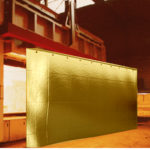

24 oz Acrylic Coated Fiberglass Curtains for Spark, Spatter and Grinding Containment, ANSI/FM 4950 Approved
Acrylic coated fiberglass curtains from Steel Guard Safety are built from 24 oz Alpha Style 2150 Weldgard, a 100% glass yarn fabric treated with an acrylic coating that reduces lint and improves workability. It is our economy grade and the highest-rated coated fiberglass in the line — the base fabric resists intermittent temperatures to 1000°F.
This is the grade for spark, spatter, slag and grinding debris rather than sustained process heat. If you’re containing oven or furnace temperature rather than flying particles, see our full High Temperature Curtains range.
ANSI/FM 4950 Approved
Alpha Style 2150 carries ANSI/FM 4950 approval for welding curtains. That matters because FM 4950 is the standard specifying welding pads, blankets and curtains for hot work protection — and it’s the certification a safety manager or insurance inspector will ask for by name when reviewing a hot work permit program.
None of our other coated fiberglass grades carry it. If your requirement is a documented, approved welding curtain rather than a heat barrier, this is the build.
Why the Highest-Rated Coated Fiberglass in the Line
This is counterintuitive, so it’s worth explaining. Every coated fabric is a substrate plus a coating, and the coating almost always fails first — silicone gives out at 500°F, PTFE decomposes around 660°F, an aluminized laminate somewhere in between. The E-glass base under all of them holds about 1000°F, but you never get to use it.
Style 2150 is different because the acrylic is a treatment rather than a barrier coating. It’s applied to reduce lint and improve handling, not to form a thick protective layer. The glass does the work, and the fabric is rated on the glass: 1000°F intermittent on the base fabric.
The trade is that a treated fabric gives you less than a coated one everywhere else. No chemical barrier, no release properties, no reflective face, less resistance to liquids. It’s a spark and abrasion product, which is exactly what a welding curtain is.
Where Acrylic Coated Fiberglass Curtains Are Used
Weld cells and fabrication bays. Containing spatter and slag between work areas, and screening arc flash from adjacent operations.
Grinding stations. Sparks and abrasive debris travel further than most people expect, and an incombustible barrier stops them without the maintenance a rigid screen needs.
Hot work permit areas. Where a contractor is cutting or welding in an occupied plant, an FM 4950 approved curtain is the documentation a permit program requires.
Temporary work cell division. Lightweight enough to hang and move, rated high enough to trust near hot work.
General heat and debris screening. Economy applications where the requirement is a barrier rather than a specific thermal performance.
Spark and Spatter Exposure
Every application below is inside this material’s range. What separates them is what’s actually hitting the curtain.
| Exposure | What Hits the Curtain | HT-1000 Fit |
|---|---|---|
| Grinding sparks | Hot particles, low mass, high volume | Ideal — incombustible, sheds particles |
| Arc welding spatter | Molten droplets, small | Ideal — FM 4950 approved for this |
| Cutting slag | Larger hot particles | Good — check drop distance and angle |
| Arc flash screening | UV and visible light | Good — opaque barrier; for viewing windows see welding screens |
| Radiant process heat | Sustained thermal load, no particles | Moderate — consider a reflective or silica grade |
| Molten metal splash | Large volume molten contact | Not suitable — use HT-3000 silica |
| Chemical or coating contamination | Overspray, solvents, migration | Not suitable — use HT-2000 PTFE |
The pattern: this material is built for particles, not for sustained heat or chemistry. Where flying spark and abrasion are the hazard it’s the most cost-effective grade we make. Where the problem is temperature held over hours, a coated or silica grade will serve you better.
Construction
- 24 oz acrylic treated fiberglass, 0.050″ thick, orange
- Balanced 400 lbs tensile in both warp and fill, so cut direction is less critical than on our silica grades
- Stainless steel thread throughout. Fiberglass thread caps at 1000°F and PTFE thread at 600°F
- Grommets every 12 inches across the top with reinforcement, with optional chain bottom and track systems
- Tracks or hangs fixed. Unlike our reflective grades, this build has no foil laminate and is not restricted to static mounting
- Built to any opening, heights from 8 to 25 feet standard and larger available
Chemical Resistance
Better than the material’s economy positioning suggests. Style 2150 resists most acids and alkalis with the exception of hydrofluoric and hot phosphoric acid, is unaffected by bleaches and solvents, and will not rot or mildew. For process environments where chemical carryover rather than contamination is the concern, that may be sufficient without stepping up to PTFE.
HT-1000 Material Specifications
| Property | Value | Test Method |
|---|---|---|
| Material | 100% glass yarns, acrylic treated | — |
| Weight | 24 oz/sq yd ±10% (815 g/m²) | ASTM D-3776 |
| Thickness | 0.050″ ±10% (1.27 mm) | ASTM D-1777 |
| Weave construction | 15 (W) × 8 (F) | — |
| Tensile strength, warp | 400 lbs minimum (71.44 kg/cm) | ASTM D-579 |
| Tensile strength, fill | 400 lbs minimum (71.44 kg/cm) | ASTM D-579 |
| Temperature resistance | 1000°F / 538°C — base fabric, intermittent | — |
| Color | Orange | — |
| Approval | ANSI/FM 4950 for welding curtains | — |
| Combustibility | Incombustible base fabric | — |
Chemical Resistance
| Exposure | Resistance |
|---|---|
| Most acids | Resistant |
| Hydrofluoric acid | Not resistant |
| Hot phosphoric acid | Not resistant |
| Most alkalis | Resistant |
| Bleaches | Unaffected |
| Solvents | Unaffected |
| Rot and mildew | Will not rot or mildew |
Curtain Construction
| Component | Specification |
|---|---|
| Thread | Stainless steel |
| Grommet spacing | 12 in on center, top, with reinforcement |
| Mounting | Track systems or fixed — no static-only restriction |
| Optional | Chain bottom, track and trolley hardware |
| Standard heights | 8 to 25 feet; larger available |
| Maximum width | No limit — built to opening |
The temperature figure describes the base fabric under intermittent exposure, which is how the manufacturer states it. We publish it that way rather than as a flat service rating. Manufacturer data sheets and SDS are available on request.
The HT-1000 is built for spark, spatter, slag and grinding debris rather than sustained process heat. It is our economy grade and our only curtain carrying ANSI/FM 4950 approval for welding curtains, which makes it the right choice for weld cells, grinding stations and hot work permit areas. For sustained oven or furnace temperature, see our HT-3000 silica build.
It describes the base fabric under intermittent exposure, which is how the manufacturer states it. The glass itself resists 1000°F; the acrylic treatment is a finish applied to reduce lint and improve handling rather than a protective coating, so the fabric is rated on the glass. For sustained heat rather than intermittent exposure, a silica grade is the better choice.
Because a treatment and a coating are different things. Silicone and PTFE are barrier coatings that fail before the glass does — 500°F for silicone, around 660°F for PTFE — so the assembly is rated to the coating. The acrylic on this fabric is a thin treatment, so the glass carries the rating. The trade is that you give up everything the coating would have provided: chemical barrier, release, reflectivity, liquid resistance.
It is the FM Approvals standard covering welding pads, blankets and curtains used for hot work protection. It matters if you run a hot work permit program, if an insurer reviews your fire protection setup, or if a contractor specification calls for approved equipment by name. This is the only grade in our high temperature curtain line that carries it.
No. Use our HT-3000 high silica cloth build. Coated and treated fiberglass will burn through where molten metal makes contact, and no amount of base fabric rating changes that.
The HT-1000 is the spark and abrasion grade. HT-2000 in PTFE coated fiberglass runs 500°F continuous and 600°F intermittent, chosen for coating lines and chemical exposure rather than for heat. HT-3000 in high silica cloth holds 1800°F continuous with a 3100°F melting point and is our most specified grade above 1000°F. HT-4000 adds an aluminized reflective face for radiant heat and energy loss, and HT-5000 adds an insulating core for holding temperature zones apart. See our High Temperature Curtains page for a full comparison.
Yes. Unlike our reflective grades, which use a foil laminate specified for static installation only, this build has no such restriction. It works on our track and roller system for moveable installations, which is common in welding bays and fabrication areas where the curtain needs repositioning for workpiece access.
Format rather than material. Curtains hang vertically to divide space and contain sparks between areas; blankets lay over equipment and surfaces to protect them directly. We build both — see our welding blanket range for covers and pads.
More than its economy positioning suggests. It resists most acids and alkalis, with hydrofluoric and hot phosphoric acid as the exceptions, and is unaffected by bleaches and solvents. It will not rot or mildew. If the concern is contamination of a coated finish rather than chemical attack on the curtain, that is a different problem — use our HT-2000 PTFE build, which contains no silicone.
Yes. All Steel Guard Safety high temperature curtains are custom manufactured to your dimensions. Panel height, width, grommet spacing and cut-outs for penetrations are all configurable. Heights from 8 to 25 feet are standard and larger is available. Call 1-800-347-8368 or request a quote online.