IN A WORLD OF SHORTCUTS, WE DON'T™



Silicone Coated Fiberglass Strip Curtains
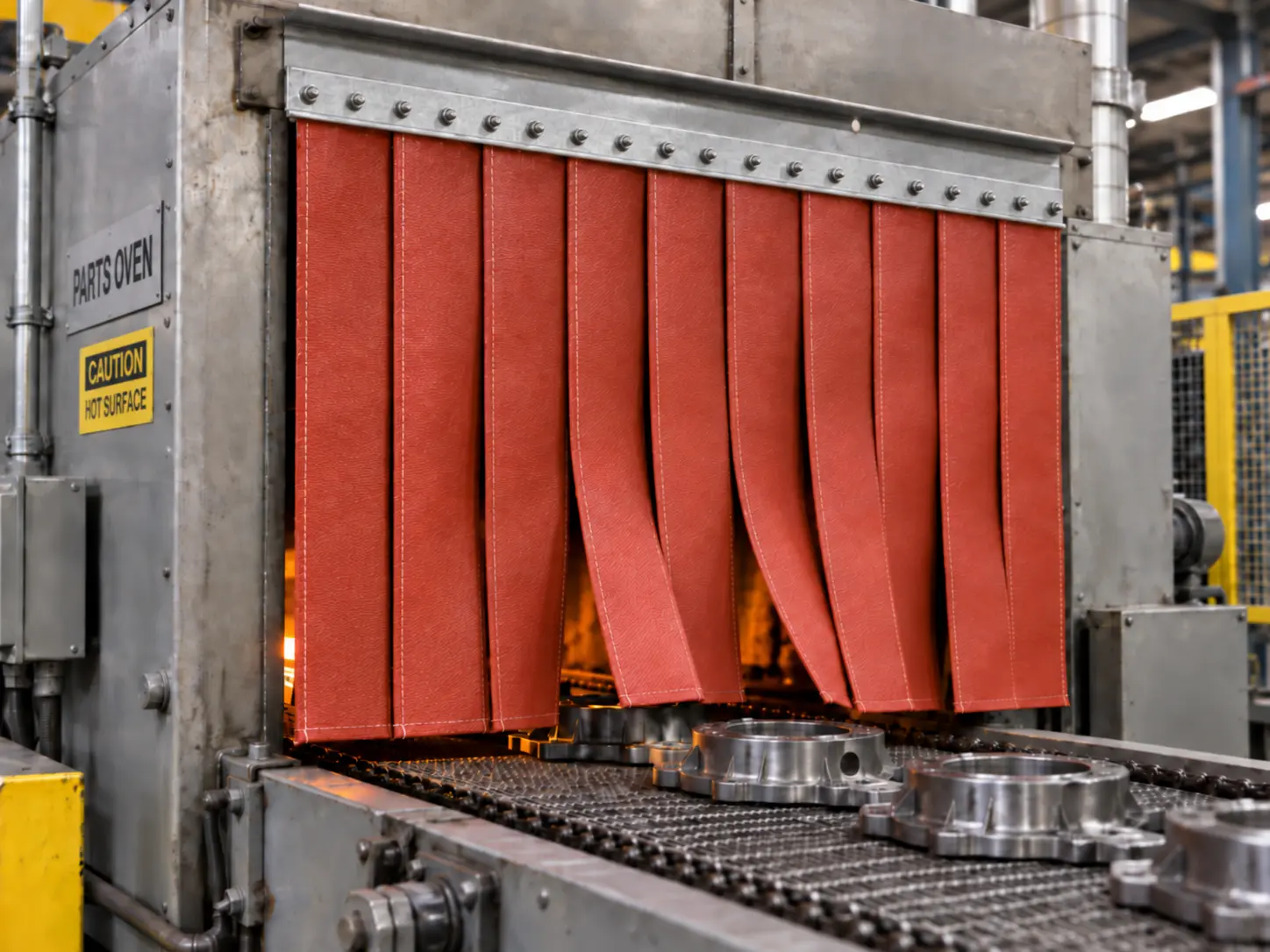


32 oz Silicone Coated Fiberglass Strip Curtains Built to Survive the Traffic That Destroys Lighter Materials
Silicone coated fiberglass strip curtains from Steel Guard Safety are the baseline build in our high temperature line and the most durable per dollar. Rated 500°F continuous on a 1000°F E-glass base fabric, the HTS-1000 is a single layer of 32 oz coated fabric — heavy enough to hang straight, recover position, and take years of forklifts and foot traffic without tearing out.
Most strip curtains fail from abrasion rather than heat. Parts drag across them, forklift forks catch the edges, and operators shove through the same two strips a hundred times a shift. Where that is the problem you’re solving, this is the build. For the full material range including reflective and non-stick options, see our High Temperature Strip Curtains line.
Why 32 oz
Coated fiberglass is sold across a wide weight range, and lighter fabric is cheaper. A 17 oz or 18 oz strip curtain will hold the same 500°F rating and cost meaningfully less — and it will billow in oven airflow, fail to recover position after someone pushes through, and wear through at the contact faces in a fraction of the time.
We build at 32 oz because a strip curtain is a wear part in a way a panel curtain is not. Every cycle puts mechanical load on the same surfaces. The heavy silicone coating gives abrasion, puncture, and tear resistance that thinner coated fabric simply does not have, and the added mass is what makes a strip hang straight and swing back rather than flutter.
What the Silicone Coating Does
- Abrasion resistance at the faces where parts and personnel contact the strips — the primary wear mechanism on any strip curtain
- Tear and puncture resistance, so a snagged corner doesn’t propagate into a split strip
- Water and oil repellency, which matters in wash-adjacent areas and wherever cutting fluid or lubricant is in the air
- Low smoke and flame retardancy
- Edge sealing, so cut strips don’t fray or shed fiber the way uncoated glass does
High-Visibility Red
Our standard silicone coated fabric is red, and that is a safety feature rather than a styling choice. A strip curtain hangs in a doorway people walk through, often in a poorly lit area of the plant, sometimes while carrying something. A high-contrast curtain reads as a barrier from across the aisle in a way a gray one does not.
Where Silicone Coated Strip Curtains Are Installed
Conveyor oven entrances and exits. The most common installation. Product runs through continuously, and the curtain contains heat while taking constant contact from whatever is on the belt.
Walk-in batch and cabinet oven doors. Hangs inside the door frame so the door still closes over it, holding temperature during cart and rack loading.
Heat treat cure-down. Controlling the rate of temperature loss as parts cool.
Drying ovens. Lower temperature, high cycle rate — an application where durability matters more than any other property.
Foundry and shop aisle separation. Dividing hot work areas from adjacent bays where the requirement is a barrier rather than a seal.
Welding and fabrication bay access. Blocking spatter and arc flash between work areas while allowing traffic through.
Traffic and Wear
Strip curtains do not wear evenly. The strips in the middle of a forklift path see far more contact than the ones at the edges of the opening, which is why we build every curtain with individually replaceable strips. Matching the configuration to what actually passes through is the difference between a curtain that lasts years and one that needs replacing annually.
| What Passes Through | Frequency | Wear Pattern | Recommended Configuration |
|---|---|---|---|
| Forklift with loaded pallets | High | Severe edge abrasion, corner tears from forks | 8″ strips, full overlap — expect periodic center strip replacement |
| Overhead conveyor, hanging parts | Continuous | Moderate, concentrated at part height | 8″ strips, full overlap |
| Hand carts and loading racks | Moderate | Moderate face abrasion at cart height | 8″ full overlap or 6″ mid overlap |
| Pedestrian traffic only | High | Light, concentrated at hand and shoulder height | 6″ strips, mid overlap — easier passage |
| Conveyor, product on belt | Continuous | Light and uniform across the opening | Butt joint — minimal drag on product |
| Occasional maintenance access | Low | Minimal | Any configuration — specify for sealing, not wear |
Two things follow from this. Wider strips mean fewer seams and fewer edges to catch, which is why heavy traffic gets 8″ rather than 6″. And if a forklift carries light or unsecured product, oversized strips can drag it off the forks — in that case go narrower and accept the trade.
When to Choose a Different Build
The HTS-1000 is the right answer when durability and heat containment are what you need. Three situations call for something else:
- Energy loss or radiant heat at the operator station — our reflective aluminized build adds a low-emissivity face that returns radiant energy to the oven
- Finish defects or surface contamination on a coating line — silicone migrates, and our PTFE build contains none
- Operating temperature above 1000°F — coated fiberglass is not an option at those temperatures; our vermiculite coated silica build holds 1800°F
Between 480°F and 500°F the HTS-1000 is the only build in our line that applies, since the reflective layer on the aluminized build limits at 482°F.
Additional Information:
Construction
- Single layer, 32 oz silicone coated fiberglass, .035″ thick
- 1000°F E-glass base fabric, with the silicone coating determining the 500°F service rating
- Stainless steel thread throughout. Fiberglass thread caps at 500°F and PTFE thread at 600°F — a thread failure drops strips regardless of how the fabric is holding up
- Grommets on 2″ centers, with universal galvanized mounting for face mount, eave, wall, or suspended installation
- Individual strips are replaceable — the single most useful feature on a high-traffic opening, since wear concentrates in the center of the path
- Built to any opening, from 3′ x 4′ batch oven doors and conveyor slots to openings 10′ wide and larger
Overlap and Strip Width
Almost every strip curtain overlap guide is written for thin PVC, and those numbers don’t transfer to coated fabric. At full overlap someone is pushing through two layers of heavy coated fiberglass. Grommets are punched on 2″ centers to match standard strip door mounting hardware, so every grommet mates with a mount hole and strip spacing is set on a 2″ grid. We build three configurations:
- Full overlap — 8″ strips with 2″ of overlap on each side. Complete double coverage and the best heat containment. Takes the most effort to push through.
- Mid overlap — 6″ strips with 1″ of overlap on each side. Same strip count and the same hardware as full overlap, using narrower strips. Noticeably easier to walk through, still a real barrier.
- Butt joint — no overlap, strips meet edge to edge. Lowest resistance and best visibility, right for continuous conveyor passthrough where drag would mark the finish.
Full and mid overlap use the same number of strips, so moving between them changes only the fabric width and the amount of coverage — the mounting hardware and strip count stay the same.
Contact one of our experienced sales reps at 1-800-347-8368 or request a quote online. Send us the opening dimensions, your operating temperature, and what passes through, and we’ll spec the build.
HTS-1000 Material Specifications
| Property | Value |
|---|---|
| Base material | Silicone coated fiberglass |
| Fabric weight | 32 oz/sq yd |
| Thickness | 0.035″ |
| Continuous service temperature | 500°F |
| Base fabric limit | 1000°F E-glass |
| Limiting layer | Silicone coating |
| Color | Red |
| Coating | Both sides |
| Water and oil repellent | Yes |
| Flame retardant | Yes, low smoke |
| Abrasion resistance | Excellent |
| Tear and puncture resistance | Excellent |
The assembly is rated to its limiting layer, not its base fabric. The E-glass substrate holds 1000°F, but the silicone coating gives out at 500°F, so that is the number the curtain carries. Above the coating limit the silicone hardens and discolors before it breaks down, exposing bare glass that begins to shed fiber — the curtain does not tear or drop, it stops being abrasion resistant. Manufacturer data sheets are available on request.
Curtain Construction
| Component | Specification |
|---|---|
| Construction | Single layer |
| Thread | Stainless steel |
| Grommet spacing | 2″ centers |
| Strip widths | 6″ or 8″ |
| Overlap options | Full 50%, Mid 33%, or butt joint |
| Mounting hardware | Universal galvanized — face mount, eave, wall, or suspended |
| Maximum size | No limit — built to opening |
| Replacement strips | Available individually by width and length |
Comparison to Other Builds in the Line
| HTS-1000 | HTS-2000 | HTS-3000 | HTS-4000 | |
|---|---|---|---|---|
| Material | Silicone coated fiberglass | Aluminized + silicone, two layer | PTFE, two layer | Vermiculite coated silica |
| Continuous rating | 500°F | 482°F | 500°F | 1800°F |
| Finished weight | 32 oz | 49 oz | 33 oz | 34 oz |
| Reflective | No | Yes | No | No |
| Silicone free | No | No | Yes | Yes |
| Abrasion resistance | Excellent | Excellent | Good | Moderate |
| Solves for | Durability, traffic | Energy, radiant heat | Contamination | Extreme heat |
500°F continuous. The E-glass base fabric holds 1000°F, but the silicone coating is the limiting layer and gives out first, so 500°F is the number that matters. If you see a silicone coated curtain advertised at 1000°F, that figure is describing the base fabric rather than the finished product.
Because a strip curtain is a wear part. Lighter coated fabric carries the same 500°F rating and costs less, but it billows in oven airflow, doesn’t recover position after someone pushes through, and wears through at the contact faces far sooner. At 32 oz the strip hangs straight, swings back, and takes years of traffic.
It depends almost entirely on traffic rather than temperature. A conveyor throat with product on a belt may run for years without attention, while a high-cycle forklift opening will wear through the center strips considerably sooner. Because wear concentrates in the middle of the traffic path, replacing a few strips is usually more economical than replacing the whole curtain — which is why we build every curtain with individually replaceable strips.
Look for discoloration, stiffening, and surface hardening of the silicone before you look for tears. Coating degradation precedes structural failure. A strip that has gone hard and chalky has lost its abrasion resistance and will start shedding glass fiber, even though it is still hanging correctly.
Three situations. If the problem is energy loss or radiant heat at the operator station, our reflective aluminized build adds a low-emissivity face. If you’re running a coating line where finish defects are the concern, silicone migrates and our PTFE build contains none. And above 1000°F coated fiberglass isn’t an option at all — that calls for vermiculite coated silica.
This one. The reflective build’s aluminized layer limits at 482°F, so between roughly 480°F and 500°F the silicone coated build is the only one in our line that applies.
Stainless steel throughout. Fiberglass thread caps at 500°F and PTFE thread at 600°F, which would put the thread at the same limit as the fabric. A thread failure drops strips regardless of how well the fabric is holding up.
Yes, and on a high-traffic opening you should plan on it. Order by strip width and length. Wear concentrates in the center of the traffic path, so the strips at the edges of the opening often outlast the middle ones by years.
Any opening. We regularly build 3′ x 4′ batch oven doors and conveyor slots as well as openings 10′ wide and larger. Every curtain is manufactured to your dimensions in our own facility.